



POLYURETHANE CEMENT
POLYURETHANE CEMENT
$132.00
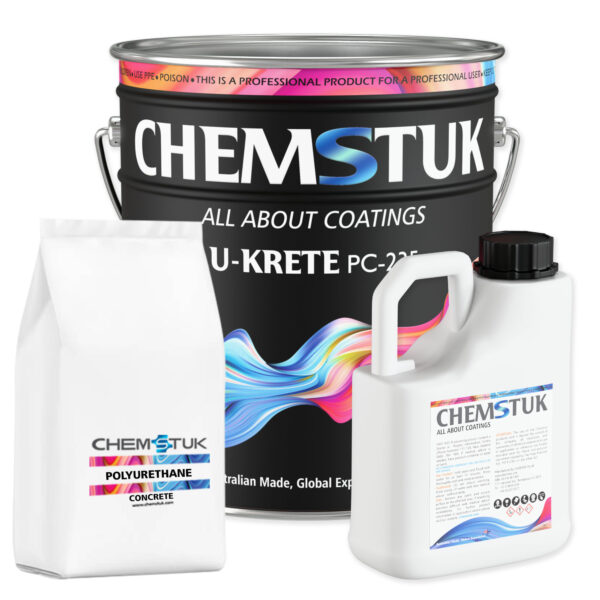
U-Krete PC-235 is a three-part polyurethane cement flooring system that combines two-pack polyurethane with micro cement and aggregate for heavy duty and wet area floors. One 4 L plus 4 L plus 15 kg kit covers up to 20 square metres at 1 mm. Some products might not be available in the stock so, it can take 7-10 working days to get them available at the store. We will send you a confirmation once your order will be ready for pick up or delivery. Orders placed over the weekend/public holiday will be processed on next working day. Any Question Give us a call on (03) 93941400 or email us on orders@singhroofingsupplies.com.au
SSL Protection
128 Bit SSL Certificate
Quick Shipping
Fast Shipping Australiawide
100% Satisfaction
We Put You First
The Full Kit
More Information
Overview
U-Krete PC-235 is a polyurethane cement floor, not a paint. It combines two-pack polyurethane with micro cement, aggregates and additives, and it is laid as a screed over an existing slab rather than rolled on. That is why it belongs in food factories, cold rooms, breweries, commercial kitchens and mining workshops, where the floor takes hot water, steam cleaning, acids and forklift traffic on the same day.
The reason it is specified over epoxy in those buildings is thermal shock. Chemstuk states that U-Krete absorbs sudden surface temperature changes and holds its integrity through daily hot water and steam cleaning, and that it can be laid from 3 mm to 10 mm. It is seamless, so there are no joints or voids for bacteria to sit in, and it can be laid to a fall.
Key Features
- Three-part system: polyurethane, hardener and cement
- Seamless, so there are no joints to harbour bacteria
- Laid from 3 mm to 10 mm depending on the specification
- Resistant to lactic acid, oleic acid, strong acids and alkalis, fats, oils and solvents
- Can be laid to a fall towards drains
- Chemstuk’s data sheet lists it as HACCP certified and non-tainting during application in food handling areas
Specifications
- Kit: 4 litres polyurethane, 4 litres hardener, 15 kg cement
- Coverage: up to 20 square metres per kit at 1 mm
- Spreading rate: 1 kg per square metre at 1 mm
- Film thickness: 1000 microns dry and 1200 microns wet as laid, normal range 1000 to 3000 microns
- Solids by weight: 99 plus or minus 0.5 percent
- Compressive strength: 30 MPa
- Recoat: 8 to 72 hours at 25 degrees Celsius
- Chemstuk states it is fully serviceable after 5 hours at 10 degrees Celsius
- Application: trowel or roller, thinned with water up to 5 percent if required
Applications
- Food and beverage production floors
- Commercial kitchens and cold rooms
- Factories, warehouses and mechanical workshops
- Mining and heavy industry
Installation
Chemstuk is direct about this one: U-Krete should only be installed by an experienced, manufacturer approved resinous flooring contractor. It goes over existing concrete or sound quarry tile, profiled first, and is laid in layers to the specification the environment calls for. Parts A and B are mixed, Part C added, and the lot mixed at low speed for three minutes without thinner.
What You Need to Complete the Job
Chemstuk’s data sheet names Primit E6-111 as the primer and Indopox as the epoxy mid coat for this build up. Depending on the specification, the installation can finish with Polyurit PU-232 or Dur-Aspart PA-944 over the top. The rest of the system is in Concrete Coatings.
Frequently Asked Questions
How is this different from an epoxy floor?
Epoxy is a coating measured in microns. U-Krete is a screed measured in millimetres, and it handles heat and thermal shock that an epoxy floor will not.
Can I lay it myself?
Chemstuk specifies an experienced, manufacturer approved resinous flooring contractor. This is a screed with a short working window, laid to a thickness, and it is not a roll-on product.
What does one kit cover?
Up to 20 square metres at 1 mm thickness. At 3 mm that same kit covers roughly a third of the area, so work out your thickness before you order.
Does it need a primer?
Chemstuk lists epoxy primers, specifically Primit, as the preceding coat. Concrete should be at least 28 days old, at least 25 N per square millimetre, and dry to 75 percent relative humidity tested to ASTM F2170.
Related Products
Related products
-
 Concrete Coatings
EPOXY GLAZE SEALER
-
Concrete Coatings
naNo-Leak FC-111
-
Concrete Coatings
QUICK BUILD CP-114 | CONCRETE REPAIR
-
Concrete Coatings
WATHANE AC-631 | WATERBASED SEALER