

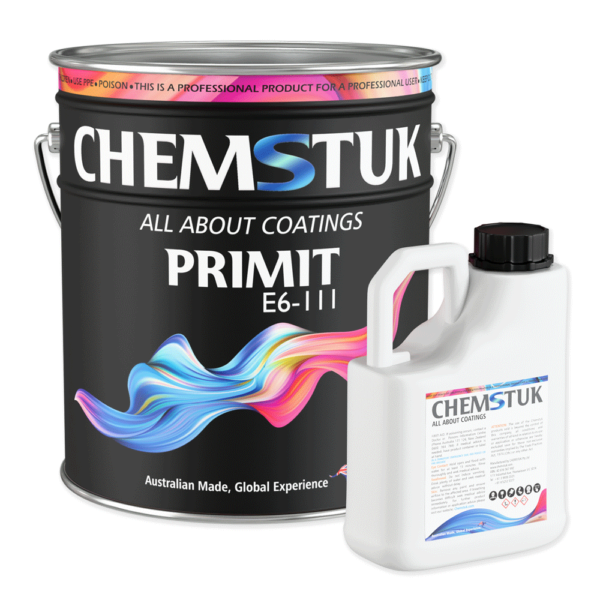
PRIMIT E6-111 | EPOXY PRIMER
PRIMIT E6-111 | EPOXY PRIMER
$240.90
Primit E6-111 is a two part penetrating epoxy concrete primer that soaks into porous concrete so the coating above keys into the slab rather than resting on it. A 16 L kit covers around 128 square metres at 8 square metres per litre. Some products might not be available in the stock so, it can take 7-10 working days to get them available at the store. We will send you a confirmation once your order will be ready for pick up or delivery. Orders placed over the weekend/public holiday will be processed on next working day. Any Question Give us a call on (03) 93941400 or email us on orders@singhroofingsupplies.com.au
SSL Protection
128 Bit SSL Certificate
Quick Shipping
Fast Shipping Australiawide
100% Satisfaction
We Put You First
The Full Kit
More Information
Overview
An epoxy floor is only as good as its grip on the slab underneath. Most floor failures are not the topcoat letting go of itself, they are the whole system peeling off concrete it never properly bonded to.
Primit E6-111 is what stops that. It is thin enough to soak into porous concrete rather than sitting on top of it, so the coating above is keyed into the slab. It is the base coat Chemstuk specifies for the Indopox, Cindopox and Polyurit systems, and it is also used on its own as a dust proofer.
Key Features
- Two part penetrating epoxy primer
- Soaks into porous concrete rather than building a film
- Base coat for the Indopox, Cindopox and Polyurit systems
- Works as a dust proofer on bare slabs
Specifications
- Pack: 16 litre kit, 12 litres base and 4 litres hardener
- Mix ratio: 3 parts A to 1 part B, by volume
- Pot life: 2 hours
- Coverage: 8 square metres per litre, so around 128 square metres per 16 litre kit
- Touch dry: 4 hours. Foot traffic: 24 hours. Full cure: 7 days
- Solids by weight: 50 plus or minus 2 percent
- VOC: maximum 560 g per litre. Flash point: 28 degrees Celsius
- Clean up: xylene
Applications
- Priming concrete before epoxy and polyurethane floor systems
- Dust proofing a slab that is not being fully coated
- Correctly prepared steel surfaces
Dry Concrete Only
Primit is not a damp proof membrane and it will not fix a wet slab. If the concrete is holding moisture, the primer and everything above it will lift, usually in blisters, a few weeks after you thought the job was finished. Test before you prime: tape a square of plastic sheet down on all four sides, leave it overnight, and lift it in the morning. Condensation underneath means the slab is still releasing moisture. Newly poured concrete needs 28 days minimum, and longer in winter.
What You Need to Complete the Job
Etch or grind the slab to an open profile, remove all laitance, and check it with a water drop test. Water that soaks in and darkens the concrete means the surface is open; water that beads means the area needs grinding. Repair damaged areas with Quick Fill PE-115 before priming. Then coat with Indopox E6-133, or seal a decorative floor with Cindopox E6-143. The full range is in Concrete Coatings.
Frequently Asked Questions
How much primer do I need?
Around 8 square metres per litre, so a 16 litre kit covers roughly 128 square metres. That figure moves more than it does with a topcoat, because a penetrating primer soaks in. A dense power trowelled slab takes less, an open slab considerably more.
Can I use too much?
Yes. A primer is meant to soak in, not build a film. Flood a dense slab and the excess sits on the surface as a glossy layer, which is exactly the weak point you were trying to avoid. If it is pooling, spread it out.
How long can I leave it before coating?
Get the topcoat on while the primer is still chemically active and you get a bond between the two rather than adhesion alone. Leave it too long and the primer skins over and has to be abraded first.
Is this a solvent heavy product?
Yes. VOC is 560 g per litre and the flash point is 28 degrees Celsius, which makes it the most solvent rich product in the range. Use a respirator with organic vapour cartridges rather than a dust mask, and keep it away from ignition sources.
Related Products
Related products
-
 Concrete Coatings
POOLPROOF EE-134 | SWIMMING POOL PAINT
-
Concrete Coatings
DUR-ASPART PA-944 | POLYASPARTIC FLOOR COATING
-
Concrete Coatings
LIQUID LASTIC PU-991 | WATERPROOFING MEMBRANE
-
Concrete Coatings
naNo-Leak FC-111