

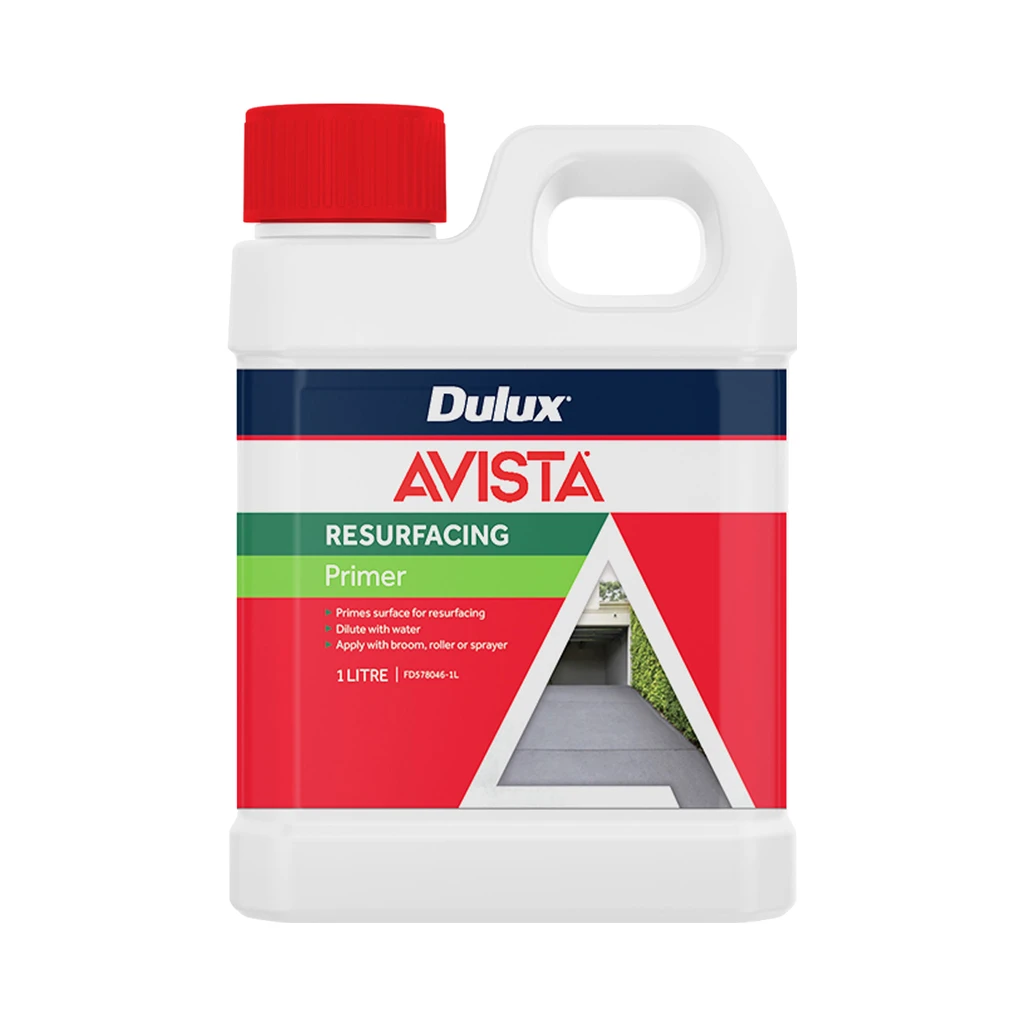
Dulux Avista Resurfacing Primer
Dulux Avista Resurfacing Primer
$45.00 – $132.50Price range: $45.00 through $132.50
Dulux Avista Resurfacing Primer. Prepares old concrete for the Avista Resurfacing Compound and stops the overlay delaminating. Apply by brush or roller before the base coat. 1L and 10L.
SKU
N/A
Category Concrete Sealers
SSL Protection
128 Bit SSL Certificate
Quick Shipping
Fast Shipping Australiawide
100% Satisfaction
We Put You First
The Full Kit
More Information
Overview
The Dulux Avista Resurfacing Primer prepares an existing concrete surface for the Dulux Avista Resurfacing Compound. It is applied after cleaning and crack repair, before the overlay goes down, and it creates the strong mechanical bond between the old concrete and the new resurfacing layer.
Getting this step right is what stops the overlay from lifting. Without a primer, a smooth or power-trowelled slab may not give the compound enough key, and the resurfacing coat can delaminate under traffic or weather. The primer is applied by brush or roller, and coverage varies with surface porosity.
Key Features
- Improves the bond between old concrete and the resurfacing overlay
- Reduces the risk of the overlay delaminating
- Applied by brush or roller after cleaning and crack repair
- Part of the five step Dulux Avista Resurfacing System
- Available in 1L and 10L packs
- Suits plain, coloured and stencilled concrete that is being resurfaced
Specifications
- Pack sizes: 1L and 10L
- Application: brush or roller
- Coverage: varies with surface porosity
- System step: applied after clean and crack repair, before the compound
- Surface: existing concrete, sound and dry
Applications
- Priming driveways before resurfacing
- Preparing patios and paths for a resurfacing overlay
- Bonding the Avista Resurfacing Compound to smooth concrete
- Part of a full Avista resurfacing system with primer, base coat and seal
What You Need to Complete the Job
Clean the surface, fill any cracks, then brush or roll on the primer and let it dry. Follow with a coat of Dulux Avista Resurfacing Compound as the base coat, coloured with a Resurfacing Oxide if you want an integral colour. In cool conditions, the Resurfacing Accelerator keeps the compound on schedule. The full system lives in the Concrete Sealers range.
Frequently Asked Questions
Do I always need the primer before resurfacing?
Yes, for the best result. The primer gives the compound a consistent surface to grip, and it is the difference between an overlay that lasts and one that lifts. On a smooth or previously coated slab the primer matters even more, because there is little mechanical key for the compound to hold onto.
Can I apply the primer over a painted surface?
Only if the existing coating is sound and well adhered. Peeling or failing paint must be removed first, because the primer and compound will only be as strong as the layer underneath. If in doubt, strip the old coating back to concrete before priming.
How soon after priming can I apply the compound?
Apply the Resurfacing Compound once the primer is dry to the touch. The exact drying time depends on temperature and humidity, so follow the product data sheet and do not rush the step. Working on a wet primer traps moisture under the overlay and risks a poor bond.
| Weight | N/A |
|---|---|
| Dimensions | N/A |
| Size | 1L, 10L |
Related Products
Related products
-
 Concrete Sealers
Dulux Avista Sealer Waterbased 20L
-
 Concrete Sealers
Dulux Avista Sealer General Purpose Matt
-
Concrete Sealers
Dulux Avista Adhesion Add 200ML
-
Concrete Sealers
Dulux Avista Waterbased Tintable Sealer Base 15L