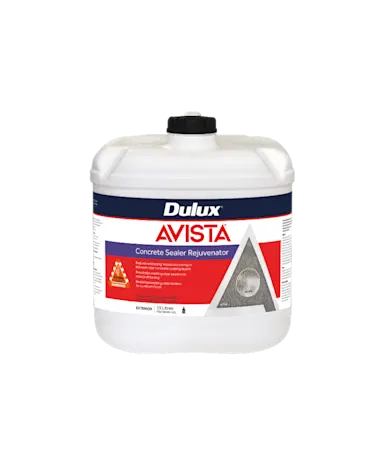
Dulux Avista Solvent Based Rejuvenator 15L — Restore and Revitalise Aged Concrete Sealers
The Dulux Avista Solvent Based Rejuvenator is a specialised treatment formulated to penetrate and reduce the whitening, milky haze, and clouding that can develop between clear concrete coating layers over time. Designed to breathe new life into aged, tired-looking sealed concrete surfaces, it restores clarity and uniformity without the need for costly and labour-intensive stripping and reapplication.
This 15-litre container is a must-have for concrete maintenance professionals and homeowners looking to extend the life of their existing solvent-based acrylic sealer. The rejuvenator works by re-wetting and re-flowing the sealer layer, filling micro-voids and re-establishing optical clarity — effectively turning back the clock on sealers that have dulled, whitened, or become patchy due to moisture ingress, UV exposure, and general ageing.
Key Features & Benefits
- Restores Clarity: Penetrates and reduces the milky white haze that commonly forms between clear sealer coats, restoring a uniform, transparent finish.
- Extends Sealer Life: Revitalises existing solvent-based acrylic sealers, delaying the need for a full strip and reseal — saving time, money, and labour.
- Targeted Treatment: Specifically engineered for Dulux Avista clear solvent-based acrylic sealers on pavers, stamped, stencilled, coloured, and exposed aggregate concrete.
- Simple Application: Applied by air spray or broom — no specialised equipment required.
- Professional-Grade Formula: Developed by Dulux for the Australian decorative concrete industry.
When to Use the Rejuvenator
This product is designed to address whitening (milky hazing) that appears between or within clear concrete sealer layers. This condition — often mistaken for efflorescence or product failure — is typically caused by moisture trapped during the coating process, over-application, or application in high humidity. The rejuvenator re-dissolves and re-flows the affected sealer layer, allowing trapped moisture to escape and restoring optical clarity.
Suitable surfaces:
- Concrete pavers
- Stamped and stencilled concrete
- Coloured concrete
- Exposed aggregate concrete
- Any surface previously coated with Dulux Avista clear solvent-based acrylic sealer
Not suitable for:
- Surfaces sealed with alkyd-based coatings
- Surfaces sealed with water-based sealers
- Efflorescence (white salt deposits — this is a different issue requiring a different treatment)
- Delamination or peeling (these are adhesion failures, not clarity issues)
- Underlying moisture problems (rising damp must be resolved before any treatment)
Application Instructions
Step 1 — Test First: Always test on a small, inconspicuous area to confirm compatibility and desired results before treating the entire surface.
Step 2 — Apply: Using an air spray unit or solvent-resistant broom, apply the rejuvenator evenly to the affected area. Avoid pooling or puddling — an even, wet coat is the goal.
Step 3 — Allow Penetration: Let the product sit on the surface for 10 minutes or more, depending on ambient temperature. The product needs time to penetrate the sealer layers.
Step 4 — Work In: Using a broom, work the rejuvenator into the sealer for 30–60 seconds, brushing in multiple directions to ensure thorough coverage and activation.
Step 5 — Cure: Allow 3–5 days for the treatment to fully take effect. If whitening persists or returns, a second application may be required.
Step 6 — Recoat (if needed): If the surface becomes slippery after treatment or you wish to apply a fresh top coat for additional protection, wait a minimum of 4–6 weeks before applying a new coat of Dulux Avista sealer.
Important: Always wear appropriate personal protective equipment (PPE) including solvent-resistant gloves, safety glasses, and respiratory protection during application. Work in a well-ventilated outdoor area.
Important Limitations
The rejuvenator is a clarity restoration treatment, not a structural repair product. It will not fix: efflorescence (white salt deposits from within the concrete), delamination or peeling of the sealer, cracks or physical damage to the concrete surface, or moisture issues originating from beneath the slab. For these problems, consult the Dulux Avista technical support team for an appropriate solution.
Frequently Asked Questions
1. What exactly causes the white, cloudy appearance on my sealed concrete?
The milky white haze — often called blushing or whitening — is typically caused by moisture trapped between sealer layers during application. This can happen when: the sealer was applied too thickly, recoating occurred before the previous coat was fully dry, application took place in high humidity or low temperatures, or the concrete itself contained residual moisture. The Dulux Avista Rejuvenator works by re-wetting the sealer film, allowing the trapped moisture to escape and the sealer to re-flow into a clear, continuous layer.
2. Can I use this on any brand of concrete sealer?
The rejuvenator is specifically formulated for Dulux Avista clear solvent-based acrylic sealers. It may not be effective — and could potentially cause adverse reactions — on other brands or on water-based, alkyd, epoxy, or polyurethane coatings. If you are unsure what type of sealer is on your concrete, test a small hidden area first, or consult a concrete sealing professional for identification and advice.
3. How long do I have to wait before I can reseal after using the rejuvenator?
You must wait a minimum of 4–6 weeks before applying a new coat of sealer over the treated surface. This extended waiting period allows all solvents from the rejuvenator to fully evaporate. Rushing this step can trap residual solvent beneath the new sealer coat, causing the very whitening problem you are trying to fix.
4. The whiteness came back after treatment — what should I do?
A single application may not be sufficient for severe or deep-seated whitening. If the haze returns within the first few days after treatment, a second application is recommended — follow the same application procedure. If the problem persists after two treatments, the whitening is likely not a surface issue but something deeper — such as rising damp, a failed bond between sealer coats, or contamination on the original concrete surface. In these cases, stripping and starting fresh may be the only permanent solution.
5. Will the rejuvenator make my surface slippery?
It can. Because the rejuvenator re-wets and re-flows the existing sealer, it may temporarily increase surface slipperiness, particularly when wet. If slip resistance is a concern, consider adding a slip-resistant additive when you eventually recoat, or apply a light broadcast of fine aggregate whilst the surface is still tacky (if recoating immediately). For high-traffic areas that become slippery, a fresh sealer coat incorporating slip-resistant additive is recommended after the 4–6 week waiting period.
6. Is the rejuvenator a substitute for stripping and resealing?
Not always. The rejuvenator is a cost-effective first-line treatment for whitening and hazing. In many cases it will successfully restore clarity and extend the life of the sealer by several years. However, if the sealer is peeling, delaminating, badly worn, or has reached the end of its service life, rejuvenation will not fix these structural failures — stripping and resealing remains the correct course of action. Think of it like polishing a scratched car panel versus repainting it: the rejuvenator polishes, but it cannot replace missing material.
7. What safety precautions should I take?
This is a solvent-based product and must be handled with care. Use only in well-ventilated outdoor areas. Wear solvent-resistant gloves, safety glasses, and a respirator with organic vapour cartridges. Keep away from naked flames, pilot lights, and any potential ignition sources — the product is highly flammable. Do not smoke during application. Keep children, pets, and bystanders well away from the work area until the product is fully dry. Store leftover product in a tightly sealed container in a cool, dry, well-ventilated area away from direct sunlight.


