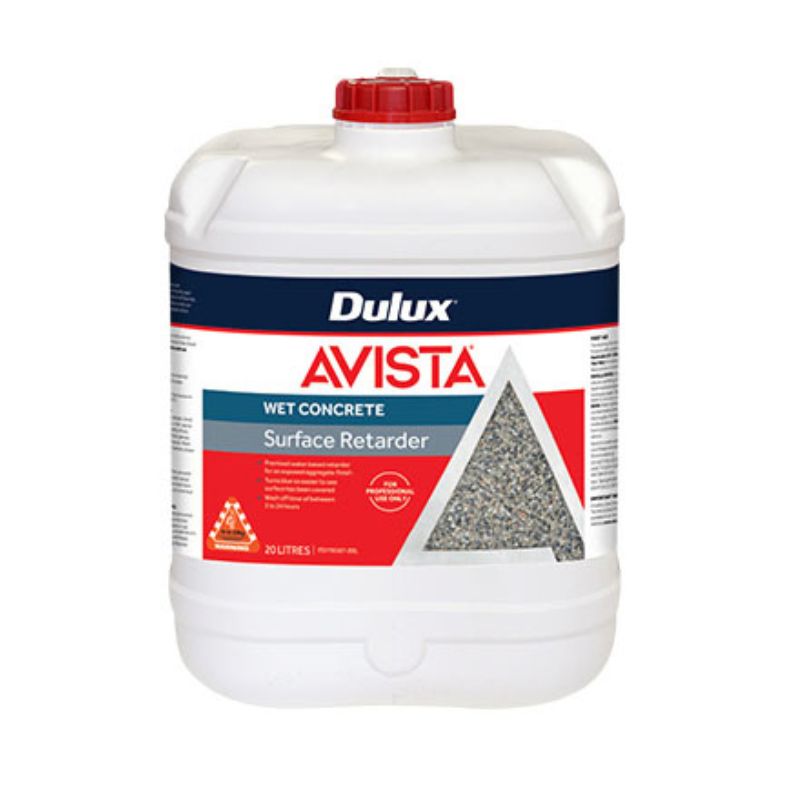
Dulux Avista Exposed Aggregate Surface Retarder 20L — Reveal the Beauty Beneath
The Dulux Avista Exposed Aggregate Surface Retarder is a ready-to-use, water-based formulation designed to create stunning exposed aggregate finishes on freshly laid horizontal concrete. By selectively delaying the set of the surface cement paste, it allows the underlying stones, pebbles, and aggregates to be revealed through a simple wash-off process — transforming ordinary grey concrete into a textured, decorative surface that is both visually striking and naturally slip resistant.
This 20-litre pail provides enough product to treat approximately 60–100 m² of fresh concrete, making it an economical choice for driveways, pathways, patios, and pool surrounds. The temporary blue tint ensures you never miss a spot during application, delivering consistent, professional results every time.
Key Features & Benefits
- Ready to Use: No mixing, diluting, or site preparation required — simply shake and spray straight from the pail.
- Blue Application Tint: The temporary blue colour provides clear visual confirmation of coverage, eliminating guesswork and missed patches. The tint fades after drying.
- Water-Based Formula: Low VOC, low odour, and easy clean-up with water — a safer choice for applicators and the environment.
- Generous Wash-Off Window: Removable between 3 and 24 hours after application, providing flexibility to suit site conditions and scheduling.
- Consistent Exposure Depth: Delivers uniform aggregate reveal across the entire treated area when applied correctly.
- Excellent Mechanical Key: Creates a rough, textured surface ideal for bonding subsequent concrete pours, renders, or overlays — eliminates the need for mechanical scabbling or acid etching.
- Cost-Effective Coverage: One 20L pail covers up to 100 m², making it an economical solution for residential and light commercial projects.
Ideal Applications
- Exposed aggregate driveways
- Decorative concrete pathways and footpaths
- Outdoor entertaining areas and patios
- Pool surrounds and coping
- Commercial landscaping and public spaces
- Precast concrete panels requiring an exposed finish
Application Instructions
Step 1 — Concrete Placement: Pour, screed, float, and finish the concrete as normal. Wait until bleed water has evaporated and the surface has lost its glossy sheen, but before initial set occurs. This is the critical window — applying too early dilutes the retarder; applying too late means the concrete has already begun setting and exposure depth will be inconsistent.
Step 2 — Apply the Retarder: Shake the pail well. Pour into a low-pressure garden sprayer and apply an even, consistent coat to the exposed concrete surface. The blue tint will clearly show where product has been applied. Two light passes are preferable to one heavy pass. Do not dilute this product.
Step 3 — Protect the Surface: Shield the treated concrete from direct sunlight, wind, rain, and foot traffic during the retardation period. Adequate curing procedures are essential for strength development of the underlying concrete.
Step 4 — Wash Off (3–24 Hours): Using a high-pressure water sprayer (minimum 2000 psi) and a stiff broom, wash away the softened surface paste to reveal the aggregate beneath. Start at the highest point and work downhill. Test a small area first to verify that the exposure depth meets your expectations. Take care not to dislodge the aggregate itself — if stones are coming loose, reduce pressure or wait slightly longer.
Step 5 — Cure and Seal: Once the surface has dried, apply a suitable curing compound and then seal with a quality concrete sealer — such as the Dulux Avista Water Based Penetrating Sealer or General Purpose Concrete Sealer — to protect the exposed aggregate from staining, weathering, and wear.
Coverage: Approximately 3–5 m² per litre (60–100 m² per 20L pail), depending on concrete mix design, aggregate size, and surface texture.
Clean-Up: Flush spray equipment thoroughly with hot water immediately after use.
Important Considerations
- Always pre-test on a small section, particularly when working with fine aggregates (6 mm, 9 mm) or concretes containing accelerators (calcium chloride, heated pours, or steam-cured elements).
- High ambient temperatures and high cement contents reduce retardation effectiveness — adjust application rate and wash-off timing accordingly.
- For best results, consult the full Technical Data Sheet and Safety Data Sheet before commencing work.
Frequently Asked Questions
1. What exactly does a surface retarder do, and how is it different from acid etching?
A surface retarder is a chemical applied to fresh, wet concrete that temporarily delays the setting of the top few millimetres of cement paste. After the main body of concrete hardens, the unset surface layer is simply washed away with water to reveal the stone aggregate beneath. Unlike acid etching — which uses harsh chemicals to dissolve cured cement and carries significant safety and environmental risks — surface retarders are water-based, safer to handle, and produce a more consistent, predictable finish with far less effort.
2. How soon after pouring concrete should I apply the retarder?
Apply the retarder after the bleed water has disappeared from the surface and the glossy sheen has faded, but before the concrete reaches its initial set. In practical terms, this is typically 30 minutes to 2 hours after finishing, depending on temperature, humidity, and concrete mix design. If you apply too early (whilst bleed water is still present), the product becomes diluted and ineffective. If you apply too late (after the surface has begun to stiffen), the exposure will be shallow and uneven.
3. Can I leave the retarder on overnight before washing?
Yes — the Dulux Avista Surface Retarder has a wash-off window of 3 to 24 hours, giving you the flexibility to wash the following morning. In cooler conditions (below 20 °C), the longer end of the window is preferred. In hot or windy conditions, check the surface periodically — if the paste becomes too hard, it will be difficult to remove. Always test a small corner before committing to a full wash-off.
4. What size aggregate works best with this retarder?
This retarder is suitable for most standard decorative aggregates, from 6 mm river pebbles up to 20 mm crushed stone blends. Finer aggregates (6–9 mm) require a more precise application and may benefit from pre-testing, as they have a smaller surface area and less margin for error. Larger aggregates (14–20 mm) are more forgiving and generally produce a bolder, more dramatic finish. Always confirm compatibility with a small test section before treating the full area.
5. Do I need to cover the concrete after applying the retarder?
Whilst the Dulux Avista Surface Retarder does not mandate covering with plastic, the treated surface must be protected from direct sunlight, wind, and rain during the retardation period. These elements can cause the retarder to dry out or wash away unevenly, leading to patchy exposure. In exposed or windy sites, covering with plastic sheeting or hessian — elevated slightly so it does not touch the surface — is a prudent precaution.
6. What if I cannot wash the surface within 24 hours?
If the wash-off window is missed and the surface paste has hardened beyond what a pressure washer can remove, your options become limited. Light mechanical abrasion (such as a floor grinder with a coarse pad) may be needed, but this risks damaging the aggregate. For this reason, it is essential to plan your pour timing so that the wash-off falls within a practical window — ideally the following morning. In consistently hot weather, consider applying in the late afternoon so the wash-off can be done early the next day.
7. Should I seal the exposed aggregate after washing?
Yes — sealing is strongly recommended. Exposed aggregate surfaces, whilst durable, have a slightly rougher texture that can trap dirt, moss, and stains. A quality concrete sealer — such as the Dulux Avista Water Based Penetrating Sealer for a natural look, or the General Purpose Sealer for enhanced colour — will protect the surface from weathering, make it easier to clean, and extend the life of your decorative concrete. Allow the concrete to dry thoroughly (typically 24–48 hours after washing) before applying the sealer.


