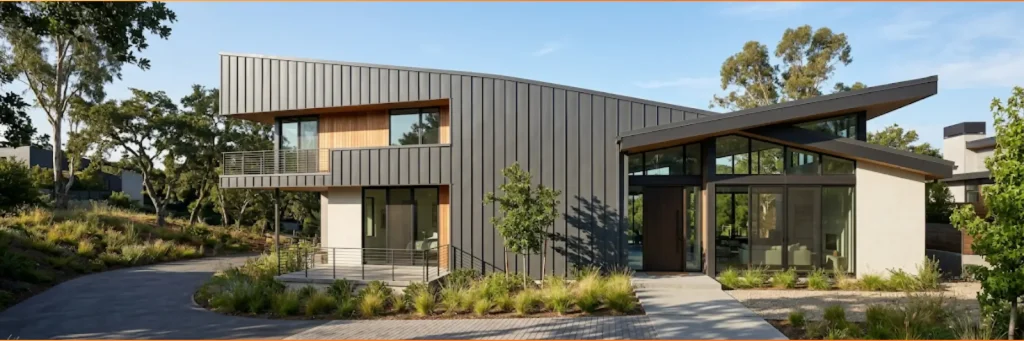
When a reroof quote lands on the counter at our Truganina store, the profile decision almost always comes down to two things: your roof pitch and how the sheets are fixed. Colorbond Trimdek roofing, traditional Custom Orb corrugated and Kliplok style concealed fix sheets all use the same BlueScope steel. What separates them is where they can legally go and where they leak 20 years later.
Here is how we walk customers through it, using the profiles we cut to length every day: Trimdeck 0.42, Colorbond Corrugated and concealed fix Metlok 700.
The 30 Second Answer
- Roof pitch between 2 and 5 degrees, standard home reroof: Trimdek
- Pitch above 5 degrees, or a heritage home: Custom Orb corrugated
- Near flat skillion or long modern runs with no visible screws: Kliplok style concealed fix (we supply Metlok 700)
Now the detail, because the edge cases are where reroofs go wrong.
Trimdek Roofing vs. Custom Orb: Minimum Pitch and Water Carrying Capacity
This is the rule that decides most Melbourne reroofs before looks even enter the conversation:
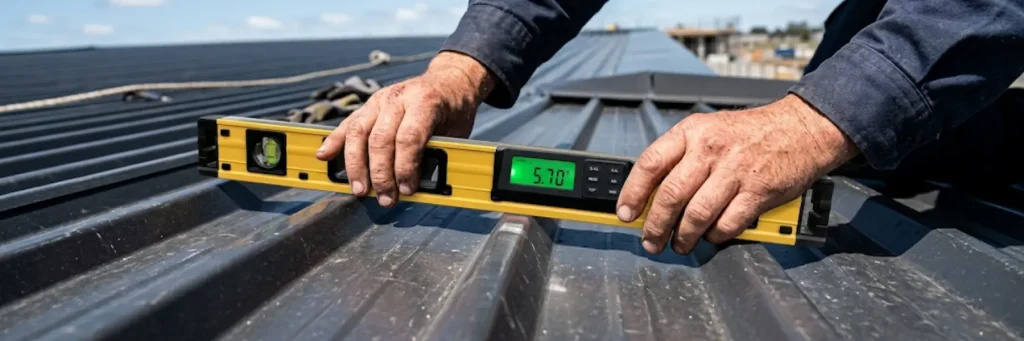
- Custom Orb corrugated needs a minimum 5 degree pitch. Its classic 16mm wave simply cannot carry heavy water at shallower angles
- Trimdek works down to a 2 degree pitch. Its deeper trapezoidal rib (21mm to 29mm depending on the brand) moves far more water per channel, which matters when a summer storm dumps a month of rain in an afternoon
- Concealed fix profiles like Metlok 700 run as low as 1 degree, which is why they dominate near flat skillions and commercial roofs
The most common mistake we see: corrugated ordered for a 3 degree rear extension because it matches the front of the house. Water ponds, capillary action pulls it back up the laps, and the ceiling stains within two winters. If your pitch is under 5 degrees, corrugated is off the table.
Pierce Fixed vs. Concealed Fix: Leak Points Over 20 Years
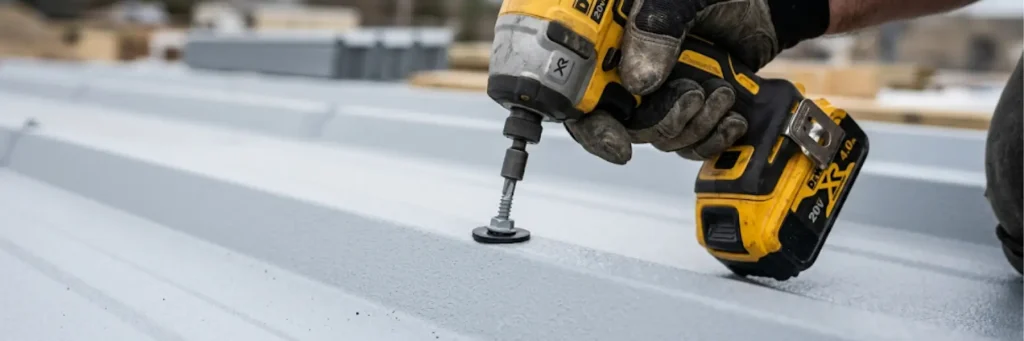
- Trimdek and Custom Orb are pierce fixed. Screws go through the sheet crest into the battens, so a typical house roof carries hundreds of penetrations, each sealed by a neoprene washer
- Those washers are the wear item. Quality screws driven to the correct torque last decades; overdriven or cheap screws are where leaks start around year 10 to 15
- Kliplok style sheets are concealed fix. Sheets snap onto Metlok 700 clips with no penetrations through the steel, so there are no washers to fail and long runs can expand and contract freely
- The trade off is cost: clips add to the supply order, installation is slower, and sheets are made to order (up to 15 metres for Metlok 700 through us)
DIY tip we give every owner builder: always fix through the crest, never the pan, and stop driving the screw the moment the washer compresses. A dimpled sheet around every screw is the giveaway of a rushed job.
Heritage Overlays: When the Council Chooses for You
Across inner Melbourne, suburbs with heritage overlays (parts of Yarra, Port Phillip and Stonnington, for example) commonly require the traditional corrugated profile on visible roof planes. Trimdek’s flat pans read as modern and can be knocked back at planning.
- Check your planning overlay before ordering sheets
- We cut Custom Orb style Colorbond Corrugated 0.42 and 0.48 to length, in heritage friendly colours
- Keep the paperwork simple: order corrugated for the street facing roof and use Trimdek or Metlok on the low pitch section behind it
Coverage Width, Screws and What It Does to Your Order
Sheet coverage quietly changes your quantity and waste:
- Custom Orb and Trimdek both cover 762mm per sheet
- Kliplok style profiles cover 700mm, so the same roof needs roughly 8 to 9 percent more sheets
- Pierce fixed jobs need roofing screws in bulk; concealed fix jobs swap most screws for clips at a higher unit price
- As a live anchor, our Colorbond Corrugated 0.48 is $19.50 per lineal metre, cut anywhere from 1.2m to 24m so offcut waste stays minimal
Whichever profile you choose, order matching trims at the same time. We fold custom flashings up to 8 metres, including apron flashings made for the Trimdek profile, so junctions seal properly on day one.
When Spandek Is the Better Call Than Trimdek
Spandek sits between the two classics: a bolder, tighter trapezoidal look with strong spanning ability at low pitches. We steer customers to it when:
- The job is a large shed, carport or commercial roof where longer spans reduce framing
- A sharper, more contemporary line is wanted on walls as well as the roof
- Trimdek would do the job, but the client wants the crisper profile for the same fixing method
Which Profile Should Your Reroof Use?
- Choose Trimdek for low pitch home roofs, extensions and value: strong, forgiving and easy to source in 0.42 or 0.48 BMT
- Choose Custom Orb corrugated for heritage streetscapes and pitches above 5 degrees
- Choose Metlok 700 for near flat roofs, long runs and a screw free finish
For background reading, see Why Colorbond Roofing is Melbourne’s Top Metal Roofing Choice and Everything You Should Know About Choosing Colorbond Roof Sheets, or browse the Singh Roofing Supplies blog.
Still weighing it up? Bring your pitch measurement and roof plan to our Truganina showroom or call (03) 9394 1400. Trimdeck orders placed before 10am are ready for delivery in about two days across Melbourne.
Frequently Asked Questions
1. What is the minimum roof pitch for Trimdek?
Trimdek can be installed on pitches as low as 2 degrees. Custom Orb corrugated needs at least 5 degrees, while concealed fix profiles such as Metlok 700 work down to about 1 degree.
2. Is Kliplok better than Trimdek?
Not universally. Concealed fix sheets remove screw penetrations and suit near flat roofs, but clips and labour cost more. Trimdek remains the better value choice for most pitched residential reroofs.
3. Can I use corrugated roofing on a low pitch roof?
No. Below 5 degrees, corrugated sheets cannot shed water fast enough and leaks are likely. Switch to Trimdek at 2 degrees or a concealed fix profile on near flat roofs.