



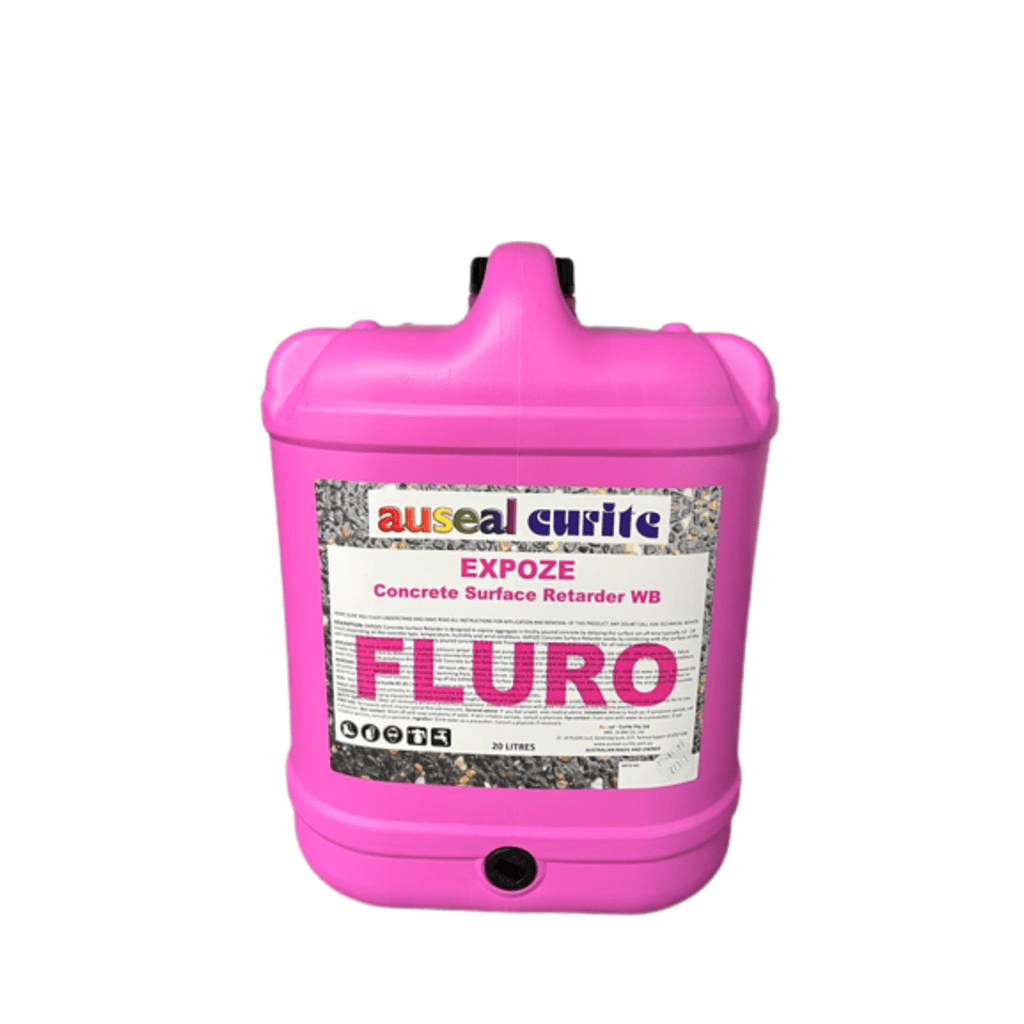
Expoze Retarder 20lt
Expoze Retarder 20lt
$100.00
Expoze Retarder 20L. Water-based concrete surface retarder that reveals the aggregate in fresh concrete for an exposed finish. Covers 80-100 m2 per pail. Wash off after 2-24 hours.
SSL Protection
128 Bit SSL Certificate
Quick Shipping
Fast Shipping Australiawide
100% Satisfaction
We Put You First
The Full Kit
More Information
Overview
The Expoze Retarder is a water-based concrete surface retarder used to make exposed aggregate finishes. It is sprayed onto freshly finished concrete to hold back the set of the surface cement paste while the concrete underneath cures normally. When the surface layer is washed off the next day, the stones are left exposed in a decorative, naturally slip-resistant finish.
The 20 litre pail covers roughly 80 to 100 square metres of fresh concrete. It is a simple alternative to acid etching or mechanical abrasion for exposing aggregate, and it suits driveways, patios, paths, pool surrounds and precast panels.
Key Features
- Water-based surface retarder for exposed aggregate finishes
- Applied with a low-pressure sprayer, roller or brush
- Delays the set of the surface paste, not the concrete below
- Gives a controlled exposure depth of 2 to 6mm
- Covers 4 to 5 m2 per litre, 80 to 100 m2 per pail
- Washed off with water or a pressure washer
Specifications
- Pack size: 20L
- Coverage: 4 to 5 m2 per litre, 80 to 100 m2 per pail
- Exposure depth: 2 to 6mm typical
- Wash-off window: 2 to 14 hours in warm conditions, up to 24 hours in moderate conditions
- Application: low-pressure spray, roller or brush before the concrete loses its sheen
- Shelf life: about 12 months in a sealed container
Applications
- Exposed aggregate driveways
- Decorative patios, paths and walkways
- Pool surrounds and coping
- Precast panels with an exposed finish
- Improving the mechanical key for a later pour
What You Need to Complete the Job
Finish the concrete, wait for the bleed water to disappear, then spray the retarder evenly over the surface before the concrete reaches its initial set. Cover the surface to protect it from sun and rain, then wash the softened paste off with water or a pressure washer once the concrete is firm enough. Seal the exposed finish with a concrete sealer such as AuSeal 20L Clear EC25 or a coloured AuSeal. More concreting supplies are in the Concreting range.
Frequently Asked Questions
When do I apply the retarder after pouring?
Apply it after the bleed water has gone and the glossy sheen has started to fade, but before the concrete sets hard. In practical terms that is usually 30 minutes to 2 hours after finishing, depending on temperature and the mix. Applying too early dilutes the product, and too late gives a shallow, uneven exposure.
How long do I wait before washing off?
Wash the surface off when it is firm enough to take a light spray without eroding, typically 2 to 14 hours in warm conditions and up to 24 hours in moderate weather. Use a pressure washer for the cleanest result, and wash the surface in sections so the softened paste does not dry back on.
Will the exposure depth be the same across the whole slab?
Not necessarily. The exposure depth of 2 to 6mm depends on the finish type, for example wood float versus steel trowel, and on how evenly the retarder is applied. Two light passes give more even coverage than one heavy coat, so the aggregate exposure stays consistent.
Do I need to seal the exposed aggregate after washing?
Yes, for the best finish and protection. Exposed aggregate is porous and stains easily, so seal it once the surface is clean and dry. A clear acrylic sealer gives a wet-look finish that deepens the stone colours, and a coloured sealer can add a tint at the same time.
| Weight | 22.40 kg |
|---|---|
| Dimensions | 30.0 × 30.0 × 32.5 cm |
Related Products
Related products
-
 General Hand Tools
3/8 MAGNETIC HEX SOCKET, LONG (65MM).
-
Fittings
12MM HOSE CONNECTOR – GRIP ‘N’ LOCK
-
-
Concrete Drains
SRB STORM PVC GRATE OFFSET 190X150MM GREY