
A gutter that leaks on its first heavy rain is almost never a product fault. Nine times out of ten, it is an install issue – wrong fall, brackets too far apart, or joins held together with nothing but silicone and hope. These are the calls we get at Singh Roofing Supplies, and the fix is usually straightforward once you know where the mistake is.
This guide covers the seven gutter installation mistakes that cause the most trouble, why each one leads to leaks or overflow, and what to do differently. Every fix ties back to a product you can pick up from our Truganina warehouse or order online.
Mistake 1: No Fall Toward the Downpipe
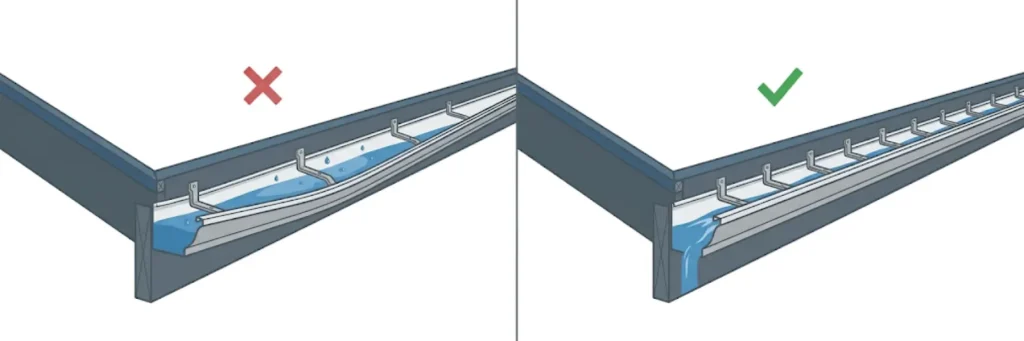
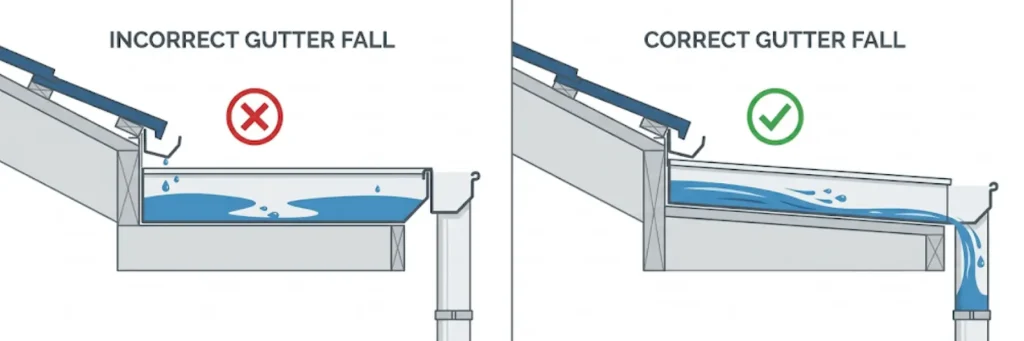
This is the number one cause of gutter overflow, and it is surprisingly easy to get wrong. A perfectly level gutter looks tidy from the ground, but water has nowhere to go. It sits in the low points, backs up at the joins, and eventually spills over the front edge and down your fascia.
The rule: AS/NZS 3500.3 requires a minimum gradient of 1:500, which works out to about 2 mm of drop for every metre of gutter. In practice, most experienced plumbers set the fall closer to 1:200 (5 mm per metre) because Melbourne’s short, heavy downpours push more water through the system than a gentle English rain.
How to get it right:
- Mark the high point at the end of the gutter run farthest from the downpipe outlet.
- Mark the low point at the downpipe position.
- Run a string line between the two marks and set every bracket to that line.
- Use our Quad Gutter Slotted 6 m lengths with pre-cut downpipe slots to ensure the outlet is in exactly the right position.
Mistake 2: Too Few Downpipes
A single downpipe on a long gutter run is a bottleneck waiting to happen. The gutter fills faster than the downpipe can drain it, and the overflow hits the fascia, the wall and eventually the foundations.
The rule: one downpipe for every 12 metres of gutter run at minimum. If your roof catchment area is large (say, a double-storey hip roof feeding a single eave), or if you are in a high-rainfall zone, you may need more. AS/NZS 3500.3 provides sizing tables that match roof catchment area, rainfall intensity and downpipe diameter.
How to get it right:
- Map your roof catchment area (plan area x roof pitch slope factor) and check it against the AS 3500.3 drainage tables.
- Standard 90 x 50 mm rectangular downpipes handle most single-storey residential runs, but consider 100 mm round downpipes for higher-volume drainage.
- Where downpipes feed into stormwater, connect using compliant PVC fittings – we stock the full Holman range for 90 mm stormwater connections.
- At the gutter-to-downpipe junction, a Colorbond rainhead prevents overflow and adds a clean architectural detail.
Mistake 3: Ignoring Roof Valleys
Roof valleys concentrate a huge volume of water from two roof planes into one narrow channel. That water hits the gutter at speed, and if the gutter beneath the valley outlet is not sized to handle the surge, it overflows at that exact point every time it rains hard.
How to get it right:
- Install a Colorbond valley gutter flashing at every internal roof intersection to channel water cleanly into the eave gutter.
- Position a downpipe within 600 mm of the valley outlet point. Do not rely on the gutter run to carry that water sideways to a downpipe at the other end of the eave.
- If debris is a concern (and it always is at valleys, since leaves and twigs wash down both roof planes into the V), install a TrimDek valley kit gutter guard or a Hytile gutter protector to keep the channel clear.
Mistake 4: Wrong Bracket Spacing (Over 1.2 m)
We have seen brackets spaced as far apart as 1.8 metres. It looks fine when the gutter is empty. Then rain fills it, the steel flexes between the widely spaced brackets, and the gutter sags. Water pools at the sag points, overflows, and eventually the weight bends the gutter permanently.
The rule: maximum bracket spacing for standard Colorbond quad gutters is 1200 mm (1.2 m). Brackets should also be placed no more than 150 mm from each join, corner and stop end.
How to get it right:
- Use internal brackets for Quad gutters at 900-1200 mm centres. Internal brackets sit inside the gutter channel, keeping the front face clean.
- Where brackets fix over roof battens, overstrap gutter brackets provide superior grip and allow for thermal expansion.
- In high-wind areas (coastal suburbs, elevated sites), reduce spacing to 900 mm.
- Always fix a bracket within 150 mm of every join and corner piece.
Mistake 5: Over-Siliconing Joins Instead of Fixing Them
Silicone is not a structural fix. We see this constantly: two lengths of gutter butted together, smeared with silicone from inside and outside, and no rivets or mechanical fasteners anywhere. The silicone stretches as the metal expands in the sun, cracks in the cold, and the joint opens up. Water gets through the gap and runs down the fascia.
How to get it right:
- Overlap gutter joins by at least 100 mm, with the upper (higher) length sitting inside the lower length so water flows over the join, not into it.
- Mechanically fasten the overlap with rivets or self-tapping screws – typically three per join (one each side and one in the base).
- Then apply a bead of quality gutter sealant along the inside of the overlap only. The sealant backs up the mechanical fix – it does not replace it.
- The same principle applies to stop ends, corners and drop outlets.
If you are not sure which sealant to use with Colorbond, check our Colorbond vs Zincalume gutter guide, which covers material compatibility.
Mistake 6: Wrong Gutter Type for Your Roof Catchment
Not all gutters hold the same volume of water. A small half-round gutter that works on a garden shed is not going to handle the catchment area of a 250 m2 roof in Werribee. Undersized gutters overflow long before they reach the downpipe.
How to get it right:
- Quad Gutter (from $7.50/m) – the most popular residential profile in Melbourne. Its square shape holds more water than round profiles, and the high front hides roof tiles for a clean finish. Suits most single and double-storey homes.
- Ogee Gutter ($15/m) – also known as K-Style. The decorative S-profile suits heritage restorations and period homes. Slightly higher capacity than quad, with a traditional look.
- Squareline Gutter ($12/m) – a modern, angular profile that pairs well with contemporary builds. Clean lines, good capacity.
Match your gutter selection to your roof area and local rainfall intensity using the AS 3500.3 sizing tables. If you are unsure, call us on (03) 9394 1400 and we will help you work it out. For a full comparison of profiles and materials, browse our guttering supplies range.
Mistake 7: Skipping the Hose Test
This one is free and takes ten minutes, yet almost nobody does it. You finish the install, pack up, go home, and the first storm reveals every problem at once. A simple hose test before you leave the site catches 90% of issues while you still have the ladder up and the tools out.
How to do it:
- Run a garden hose at full pressure into the gutter at the highest point of the run (farthest from the downpipe).
- Watch the water flow toward the downpipe. It should move steadily with no pooling. If water sits anywhere, your fall is wrong at that point.
- Check every join, corner and stop end from below. Any drip means the sealant or mechanical fix needs attention.
- Confirm the downpipe handles the flow without backing up at the outlet.
- Run the hose for at least five minutes – short bursts will not reveal slow leaks.
It is the cheapest quality check you will ever do. Fix problems now, not after the first storm when you are on the phone to your insurer.
The Right Way: A Quick NCC-Compliant Gutter Checklist
Before you sign off on any gutter job, run through this list:
- Fall: minimum 1:500 gradient toward the downpipe (1:200 recommended for Melbourne rainfall).
- Downpipes: one per 12 m maximum. Sized to roof catchment area per AS 3500.3.
- Valleys: dedicated downpipe within 600 mm of every valley outlet.
- Brackets: 900-1200 mm centres. Within 150 mm of every join, corner and stop end.
- Joins: 100 mm overlap, mechanically fastened with rivets, then sealed inside.
- Gutter size: matched to roof catchment and local rainfall intensity.
- Hose test: five minutes at full pressure. Check flow and every connection from below.
- Gutter guard: installed over valleys and in areas with heavy tree cover to prevent blockages.
With Melbourne averaging around 650 mm of rainfall per year – and much of it falling in short, intense bursts – getting your rainwater management right the first time is not optional. Every item on this checklist connects to a product you can pick up or order from Singh Roofing Supplies, from the guttering and fascia accessories to the rivets, sealants and gutter guards that finish the job properly.
Need the right tools on site? Our guide to the top 10 tools every metal roofing pro needs covers the essentials.
FAQ and Tips
What fall should gutters have toward the downpipe?
AS/NZS 3500.3 sets a minimum gradient of 1:500, which is about 2 mm of fall per metre. In Melbourne, most plumbers recommend 1:200 (5 mm per metre) for reliable drainage during heavy rain. Mark your fall with a string line before fixing any brackets.
How many downpipes do I need?
At least one downpipe for every 12 metres of gutter. For larger roof catchments or complex rooflines, add more. Always place one within 600 mm of any roof valley outlet.
What is the correct bracket spacing for quad gutters?
No more than 1200 mm apart, with brackets within 150 mm of every join, corner and stop end. We stock both internal brackets and overstrap brackets for Quad gutter systems.
Can I use silicone alone to seal gutter joins?
No. Silicone is a sealant, not a structural fastener. Always overlap the join by at least 100 mm, rivet or screw the overlap mechanically, then apply sealant on the inside only. Silicone-only joins fail within months.
Which gutter profile holds the most water?
Of the standard residential profiles, Quad Gutter and Ogee (K-Style) both offer strong capacity. Quad is the most popular choice across Melbourne for its balance of capacity, appearance and price.
Do I need a gutter guard?
If you have trees within dropping distance of your roof, yes. Blocked gutters overflow even when everything else is installed perfectly. We carry the Hytile gutter protector for general use and the Screen Tech TrimDek valley kit for metal roof valleys.
Need help putting your gutter materials list together? Call the team at Singh Roofing Supplies on (03) 9394 1400, email orders@singhroofingsupplies.com.au, or visit us at 2/1 Network Drive, Truganina VIC 3029. We deliver Australia-wide, with same-day or next-day delivery across Melbourne.