
We get this call at the Truganina warehouse at least twice a week. Someone is ordering corrugated iron sheets for a re-roof, and when we ask what pitch they are working with, the answer is a long pause followed by something like “pretty flat, I reckon” or “steep-ish”. That is not a number you can build to. And it is definitely not a number you can match to a minimum-pitch warranty table.
So we put together this roof pitch calculator and a quick field guide on how to actually measure roof pitch, step by step, using tools most tradies and DIYers already own. Measure it once, plug the numbers in, and you will know your roof pitch in degrees before you place your order for metal roofing sheets.
What Roof Pitch Actually Means
Roof pitch is simply how steep your roof is. In Australia we measure it in degrees. A flat carport might sit at 2 degrees. A classic suburban hip-and-gable roof in Melbourne is typically around 22.5 degrees. A steep Federation gable can push past 35 degrees.
You will also bump into two other formats:
- Rise over run – the vertical rise for every unit of horizontal run. A 200 mm rise over a 600 mm run is a ratio of 1:3.
- X-in-12 notation – common in American resources. A “4 in 12” pitch means the roof rises 4 units for every 12 of run (about 18.4 degrees).
For Australian building approvals, Colorbond installation manuals and manufacturer warranties, degrees is the standard you need. That is what our roof slope calculator outputs below.
Roof Pitch Calculator
Enter your rise and run measurements in millimetres. The calculator returns your roof pitch in degrees, the slope factor (you will need this to work out sheet quantities) and the rafter length per metre of plan run.
Quick example: you measure 200 mm of rise over a 600 mm run. Plug those in and you get 18.4 degrees, a slope factor of 1.053, and a rafter length of 1.053 m for every metre of plan run. That slope factor is the multiplier you use to turn your plan area into actual roof area so you order enough sheets.
Three Ways to Measure Pitch on a Real Roof
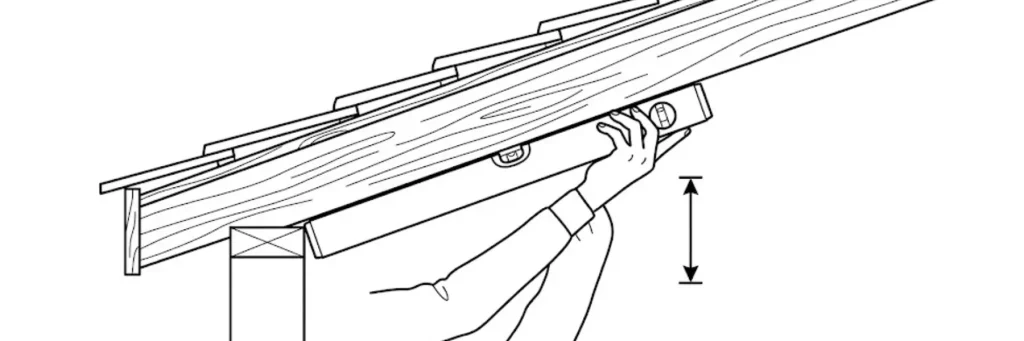
You do not need survey equipment. A spirit level, a tape measure and five minutes will give you a number accurate enough to choose the correct profile and order your materials. Here are the three methods we recommend, starting with the most popular one on site. (For a full toolkit rundown, see our guide to the top 10 tools every metal roofing pro needs.)
Method 1: Spirit Level on the Rafter Underside (600 mm Run)
This is the go-to for most carpenters and apprentice roofers.
- Hold a 600 mm spirit level flat against the underside of a rafter. Keep one end touching the rafter and level the bubble.
- With your tape, measure the vertical gap between the free end of the level and the rafter surface. That gap is your rise.
- Enter 600 as the run and your gap measurement as the rise in the calculator above.
Field tip: always check your level is not warped. A damaged level can throw your reading by a full degree, which makes a real difference when you are working near the 5-degree minimum for Colorbond corrugated roofing 0.48.
Method 2: Inside the Roof Space (Half-Span and Total Rise)
If you can get into the roof cavity, you can measure without climbing onto the roof at all.
- Measure the horizontal distance from the ridge to the external wall plate (the half-span). That is your run.
- Measure the vertical height from the ceiling joist to the underside of the ridge board. That is your rise.
- Enter both into the calculator.
This method works especially well on existing homes where you are replacing old tiles or cement sheets with new Colorbond corrugated 0.42 or upgrading to Trimdek roofing. You get the pitch confirmed before you commit to a profile.
Method 3: Inclinometer or Smartphone App (Calibrate First)
Digital inclinometer apps can give you roof pitch degrees directly, but they drift 1-2 degrees out of the box.
- Calibrate the app on a surface you have confirmed as level with a spirit level.
- Place the phone flat on the rafter or the top of a roofing sheet and read the angle.
- Take three readings at different spots along the same slope and average them.
A dedicated digital inclinometer (around $30-$50) is worth the investment if you measure roofs regularly. Phones are good for a quick sanity check, not for signing off on a build.
Minimum Roof Pitches for Metal Roofing (AS 1562.1)
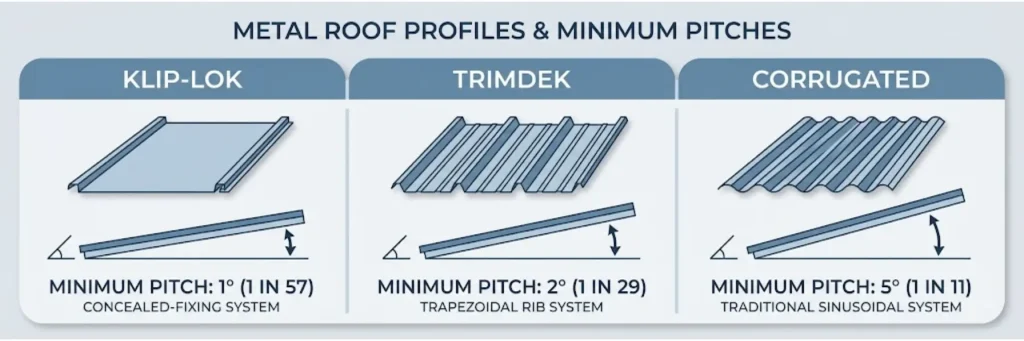
Your pitch number is not just academic. AS 1562.1 sets minimum pitches for each metal roofing profile, and installing below those limits voids the manufacturer warranty and risks water pooling at sheet laps. Here is what you need to know for the three most popular profiles we stock at Singh Roofing Supplies.
Klip-Lok / Metlok 700 – Down to 1 Degree
- Concealed-fix profile. No exposed screws on the surface.
- Minimum pitch of 1 degree (about 1:60 grade) when installed with 0.48 BMT steel.
- Ideal for modern skillion roofs, flat carports and architecturally designed homes.
- We stock Colorbond Metlok 700 sheets cut to your required length, up to 15 metres.
Trimdek – Down to 2 Degrees
- Trapezoidal rib profile used across residential and commercial builds.
- Minimum pitch of 2 degrees per the Lysaght installation manual.
- A solid choice for patios, verandahs and low-pitch extensions where corrugated will not work.
- Browse our full Trimdek range in both 0.42 and 0.48 BMT options.
Corrugated Colorbond – 5 Degrees Minimum (7 Degrees Cyclonic C/D)
- The classic Australian roofing profile, pierce-fixed through the sheet crest.
- Requires a minimum 5-degree pitch under standard wind conditions.
- In cyclonic regions rated C or D, BlueScope recommends a minimum of 7 degrees.
- Covers roughly 95% of all residential metal roofs in Australia.
- Our Colorbond corrugated 0.48 BMT is the go-to for standard residential re-roofs at $19.50 per metre, and we also carry the 0.42 BMT option if budget is tighter.
Not sure which profile suits your pitch? Our guide on choosing Colorbond roof sheets walks through profiles, thicknesses and colour options in detail.
Slope Factor: Converting Plan Area to Real Roof Area
This is where a lot of DIYers under-order and end up waiting on a second delivery. Your building plans show the roof from above – a flat projection. The actual roof surface is larger because it slopes upward. The slope factor bridges that gap.
Formula: Slope factor = 1 / cos(pitch in degrees)
Here are the most common values:
- 5 degrees = slope factor 1.004 (barely differs from plan area)
- 15 degrees = slope factor 1.035
- 22.5 degrees = slope factor 1.082
- 30 degrees = slope factor 1.155
- 45 degrees = slope factor 1.414
Worked example: your plan area is 180 m2 and the pitch is 22.5 degrees. Actual roof area = 180 x 1.082 = 194.8 m2. That extra 14.8 m2 could mean four or five extra sheets of corrugated Colorbond. Miss them and you have a half-finished roof and a wasted day.
The slope factor also affects your roofing screws estimate. Fixing centres are measured along the actual rafter length, not the plan length, so a steeper pitch means more screws per bay. We stock Bremick roofing screws in bulk packs for exactly this reason.
NCC 2022 Condensation and Sarking for Low-Pitch Roofs
If your pitch is under 10 degrees, pay close attention here. The NCC 2022 update tightened the rules on condensation management, and low-pitch metal roofs are the most vulnerable. Warm, moist air from inside the house rises, hits the cold underside of the sheeting, and condenses. Over time that damages timber battens and insulation.
What you need to know:
- Sarking is now mandatory for most metal-clad roofs in Climate Zones 6, 7 and 8 (Melbourne and most of regional Victoria fall into Zone 6).
- You need a ventilation pathway between the sarking and the metal sheeting. The Proctor ventilation batten is designed for exactly this – it sits between the sarking and the roofing sheet to maintain a continuous air gap.
- Condensation risk analysis under NCC 2022 Part F8 may require additional vapour barriers on very low-pitch skillion roofs.
We stock two sarking options suited to metal roofs: the Rhino heavy-duty metal roof sarking (1350 mm x 60 lm, 81 m2 per roll) and the Rhino heavy-duty roof sarking (1500 mm x 30 lm, 45 m2 per roll). Both are foil-laminate membranes that act as a radiant barrier while managing moisture. For a deeper explanation of sarking types and BCA requirements, read our roof sarking guide.
If your low-pitch roof also needs insulation under the metal cladding, the Bradford Anticon 60 insulation blanket combines glasswool with a reflective foil facing in one product. It handles thermal insulation, condensation control and rain noise in a single install.
With construction costs in Melbourne forecast to rise around 4% in 2026 (Illustrarch, June 2026), getting your material list right the first time saves more than just a delivery fee.
Buying the Right Sheet for Your Pitch
Once you have your pitch confirmed, matching it to the right profile is the easy part. Here is how we think about it at Singh Roofing Supplies:
- 1-2 degrees: Colorbond Metlok 700 (concealed fix, screw-free finish, sleek modern look).
- 2-5 degrees: Trimdek (trapezoidal rib, versatile for residential and commercial).
- 5 degrees and above: Corrugated Colorbond (the classic Australian profile, flexible enough for bullnose verandahs).
- 15 degrees and above: Any profile works. At steeper pitches, your main concern shifts to wind uplift zones and fixing patterns.
Do not forget the accessories that finish the job. Your pitch directly affects which flashings and box gutters you need – we manufacture custom flashings in-house in every Colorbond colour, with lengths up to 8 metres. A Colorbond valley gutter flashing is essential at any internal roof junction, and ridge capping needs to match your pitch angle to sit properly.
Browse the full Colorbond steel roofing range to compare profiles and BMT options. For colour matching, our Colorbond colour chart covers all 22 current core colours.
FAQ and Tips
How do I calculate roof pitch in degrees?
Measure the vertical rise and horizontal run, then divide rise by run and take the inverse tangent (arctan). Our calculator above does the maths for you. A 200 mm rise over a 600 mm run gives 18.4 degrees.
What is the minimum roof pitch for Colorbond corrugated roofing?
Five degrees under standard wind conditions (AS 1562.1). In cyclonic regions rated C or D, BlueScope recommends 7 degrees. Going below the minimum voids the manufacturer warranty and risks water sitting at sheet laps.
What is a slope factor and why does it matter?
Slope factor converts your flat plan area into the actual sloped roof area. Multiply plan area by the slope factor to work out how many sheets to order. At 22.5 degrees, the factor is 1.082, meaning your roof is roughly 8.2% larger than the plans show.
Can I use a smartphone to measure roof pitch?
Yes, but calibrate the app first on a known level surface. Phone accelerometers can drift by 1-2 degrees. Average three readings from different points on the same slope for a more reliable number.
What pitch do I need for a carport or patio in Melbourne?
Most carports and patios in Victoria sit between 2 and 5 degrees. A Trimdek or Metlok 700 profile handles those lower angles. Make sure you pair the right profile with the right sarking and ventilation for NCC compliance.
Do I need sarking on a low-pitch metal roof?
Under NCC 2022, yes, for most metal roofs in Melbourne’s climate zone (Zone 6). Low-pitch roofs are especially prone to condensation. We stock Rhino metal roof sarking and Bradford Airomatic roof vents to cover both the membrane and the airflow side of the equation.
How do I convert pitch from X-in-12 to degrees?
Divide the rise number by 12, then take the arctan. A 4-in-12 pitch works out to arctan(4/12) = 18.4 degrees. Or just enter 4 as the rise and 12 as the run in our calculator above.
Need a hand putting your materials list together? Call the team at Singh Roofing Supplies on (03) 9394 1400, email orders@singhroofingsupplies.com.au, or visit us at 2/1 Network Drive, Truganina VIC 3029. We deliver Australia-wide.